
Grundy Projected and Actual Dates
Three IDOC labels must remain separate. Projected Parole Date is commonly the expected date of physical prison release to mandatory supervised release. Last Paroled Date records an actual past move from prison to supervision and is stronger evidence that the prison-release event occurred. Projected Discharge Date is the expected end of the full IDOC sentence and supervision. A person can therefore be outside prison while an active state sentence continues.
Pretrial custody works differently. A person held on pending Grundy charges may have no set release date. A court order, dismissal, new conditions, another warrant, or a later sentence can control what happens. The docket may show legal authority before jail staff complete discharge. For exact physical departure, request the Sheriff custody row.
A county departure can also be a transfer. The Grundy jail handbook says a sentenced person may move to IDOC at any time after sentencing. That person left Grundy custody but did not leave confinement. The destination field, court mittimus, and later IDOC admission distinguish transfer from community release.
Find a Grundy Release Date
- Determine whether the person is in Grundy County Jail, IDOC, another county, federal custody, or another system.
- For a state prisoner, open the IDOC offender-search landing page and continue to the live form.
- Search by Last Name, IDOC Number, or Birthdate. Try name variants and compare sentencing county, birthdate, number, and physical identifiers.
- Copy Offender Status, Location, Admission Date, Projected Parole Date, Last Paroled Date, and Projected Discharge Date exactly as labeled.
- For a county sentence or pending case, read the Grundy Judici disposition and ask the jail records unit for existing calculated release or discharge information.
- After the expected date, recheck status and use VINE or an agency record to confirm what occurred.
The IDOC profile can also show Parent Institution, sentencing rows, custody date, sentence, mittimus information, and whether a sentence row is discharged. A partial surname may find variants. An IDOC number resembles K01234. The public form is session-driven, so an individual result may not have a stable link.
IDOC's official search page is the proper entry point.
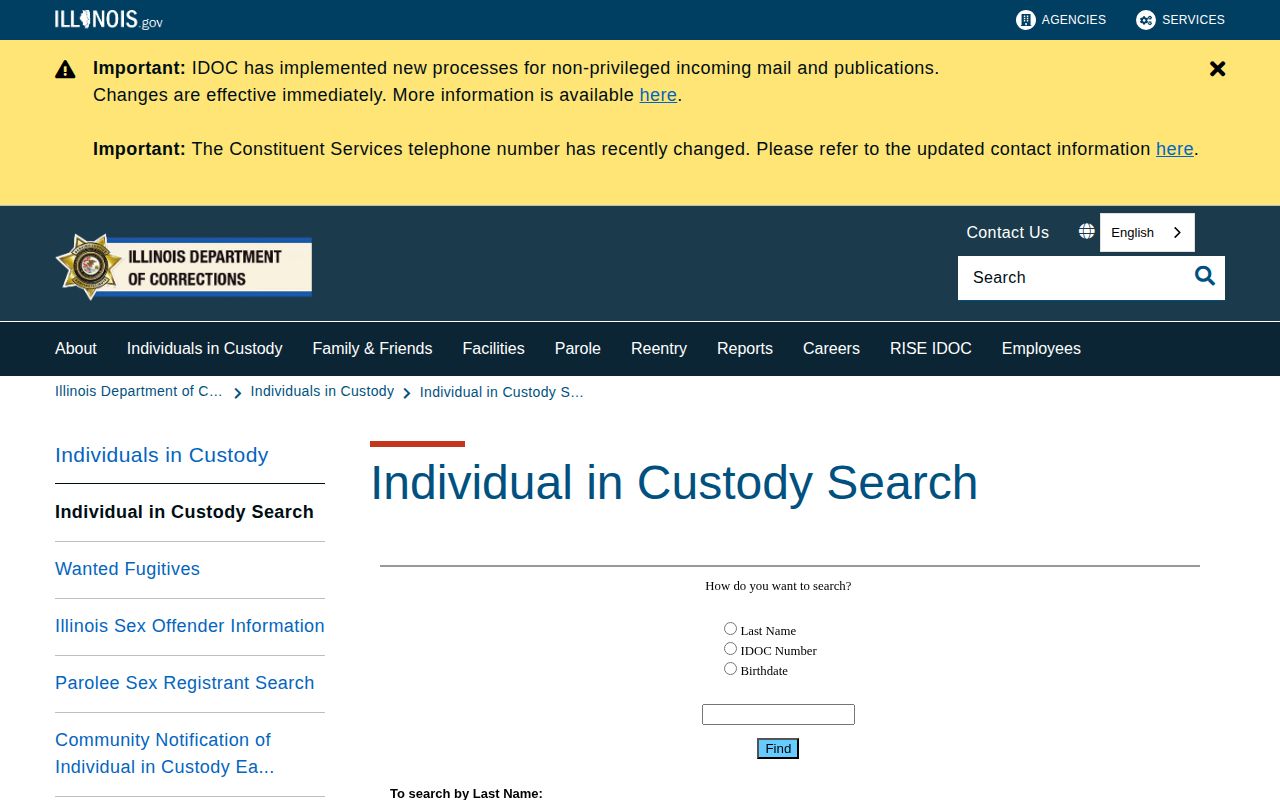
The landing page leads to the live fields used to locate the current projection for a person in state records.
Illinois Sentence Credit Rules
Illinois sentence credit cannot be reduced to one safe percentage. Under 730 ILCS 5/3-6-3(a)(2.1), many unrestricted offenses receive one day of credit for each day imprisoned, the source of the common 50 percent shorthand. Offense type, offense date, disciplinary record, program eligibility, jail custody credit, and consecutive or concurrent sentence structure can change the result. Do not calculate a promised date from the shorthand.
Specified offenses and dates carry stricter limits. Some structures require 85 percent through a 4.5-days-per-month credit limit. Other categories require 75 percent or 100 percent. Earned discretionary sentence credit and program credit have separate eligibility rules, statutory floors, exclusions, and agency decisions. Credit may be awarded, withheld, revoked, restored, or recalculated.
IDOC's sentence-credit explanation places those rules in the state search context.
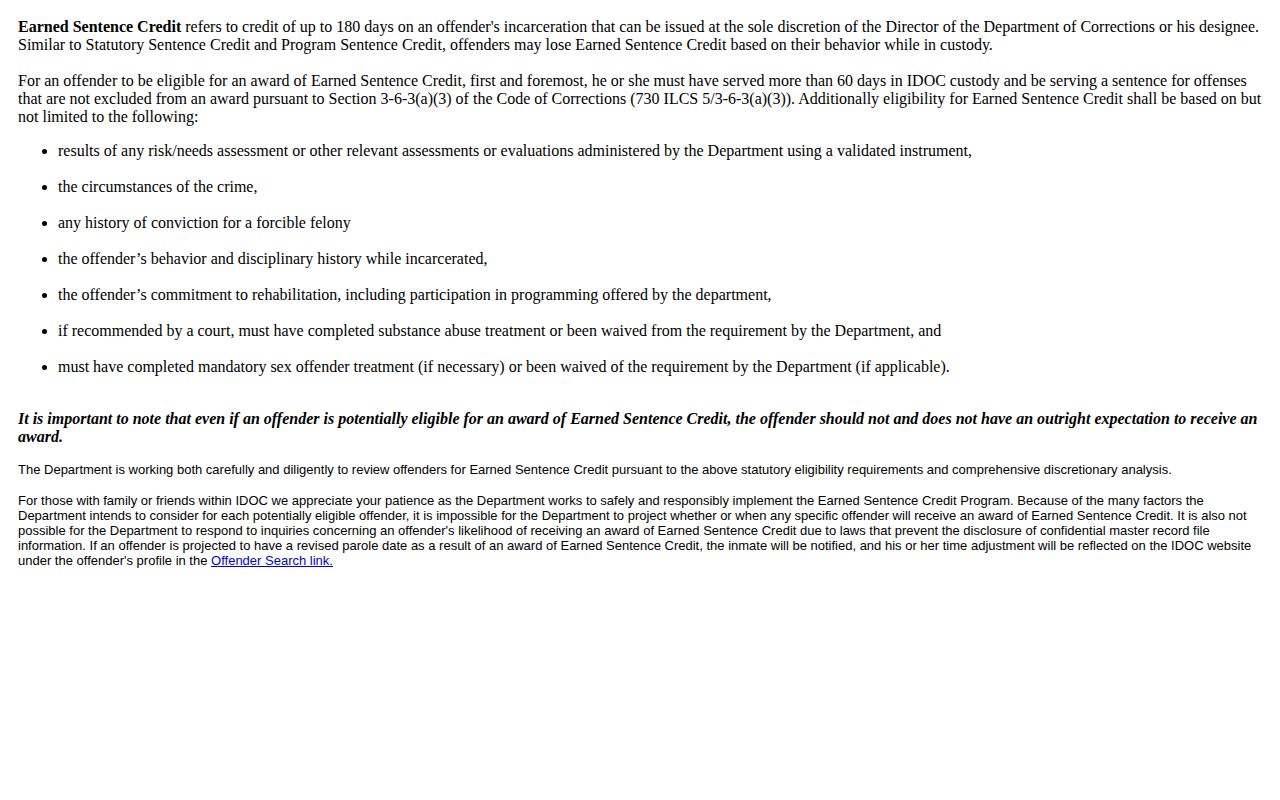
The official explanation is a guide to the framework, while the named profile remains the public source for the agency's current projection.
For a Grundy County jail sentence, do not import an IDOC formula. Obtain the court sentence, the custody-credit determination, and the jail's own calculated information. The research found no county-specific weekend-release rule or published local good-time formula.
Why Grundy Release Dates Change
| Factor | Effect on the displayed date |
|---|---|
| Custody credit | Verified time already served may alter the balance |
| Sentence credit | An award, loss, restoration, or correction may move the projection |
| Court order | An amended judgment or corrected mittimus can change the calculation |
| Sentence structure | Concurrent or consecutive terms affect the aggregate date |
| Detainer or warrant | The named custodian may release or transfer the person to another authority |
| Supervision action | Revocation can return someone to custody after a prior release |
Capture the profile with the date checked and its exact label. Then compare later records. A move in Projected Parole Date does not make the earlier capture false; it shows that the calculation changed. Last Paroled Date becomes the better public field after a prison-release event.
Do not assume an 85 percent rule applies based on a short charge label. The governing offense, date, sentence, and statute matter. IDOC performs the state calculation. The sentencing court record explains the legal term, while the corrections record shows how the custodian currently applies it.
Confirm a Grundy Release Date
Use two records when precision matters. The court disposition or order explains the legal authority. The custody log explains physical departure. For Grundy County Jail, request the date and time received, date and time discharged or transferred, release or disposition code, and destination or receiving agency if recorded. Illinois FOIA section 2.15 expressly covers key chronological arrest and custody fields, although exemptions and court restrictions can apply.
For an expected IDOC departure, register through the VINE Inmate Check while the person remains in custody. Preserve the reporting agency and event words. Then compare IDOC Offender Status and Last Paroled Date. VINE is timely notice, not a certified record, and release from prison may begin MSR rather than end the sentence.
A no-match IDOC result is not a clean historical answer. IDOC states that a profile may disappear after sentence and parole are discharged. Misspelling, county-only custody, and another jurisdiction are other explanations. For final discharge, pair the court record with written IDOC confirmation. The Public Information Office address published in the research is 1301 Concordia Court, P.O. Box 19277, Springfield, IL 62794-9277, with general phone 217-558-2200.
Grundy Earned-Credit Release Notices
Illinois maintains a narrow online notice for releases accelerated by earned discretionary sentence credit. Section 3-6-3(a)(5) requires advance notice to the prosecutor and a recent-photo online entry around release. The entry remains through the first year of MSR or until return to custody, depending on the statutory path.
The IDOC earned-credit notice page can corroborate this special category.
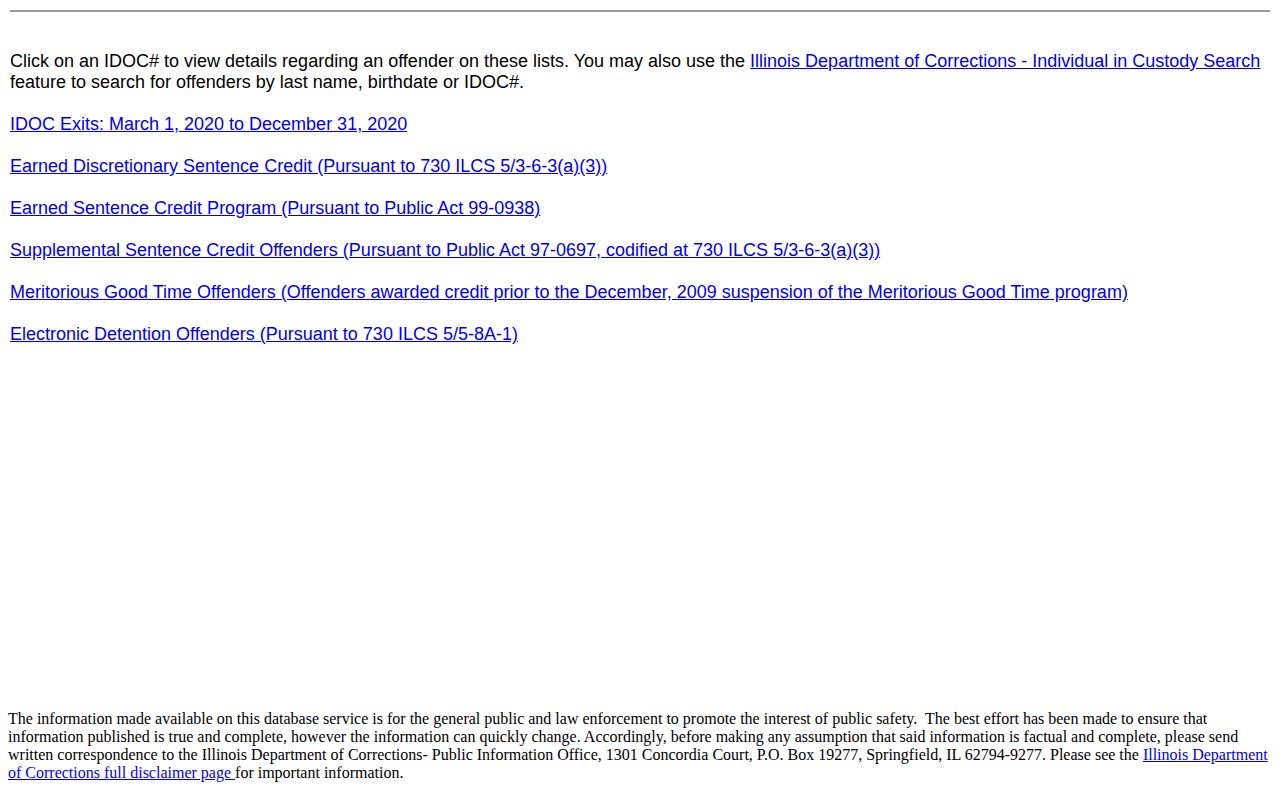
This list is not a general state release feed. Its absence does not disprove release, and its presence does not establish final discharge from supervision.
Read a notice with the main IDOC profile, VINE event, and court sentence. The statute explains why this subset receives added notice. It does not create a universal list of everyone leaving an Illinois prison, nor does it supply a county-jail projection for Grundy.
Other Custodians, Other Dates
A BOP result uses federal meanings. A past Release Date with no institution can mean the person left BOP custody. A future date remains projected, and labels such as Unknown, In Transit, or community-corrections placement do not prove final release. USMS pretrial custody may require the federal docket and an agency-record request because there is no equivalent public historical locator.
ICE's locator shows current qualifying immigration custody, not a historical release date. A Grundy transfer on an immigration detainer can mean the person left the county jail but entered ICE authority. No locator result can reflect release, removal, transfer, mismatch, or timing. State only what each named custodian's record establishes.
Grundy County Date Checklist
Before sharing a date with family or counsel, record the person's full identifying details, the custodian, the exact field label, and the time the source was checked. Note whether the date is projected, accomplished, or the expected end of supervision. Then identify the second source that can corroborate it. For a county event, that is usually the Sheriff discharge or transfer row and the court order. For a state event, compare the IDOC profile with VINE or a written IDOC record.
Recheck after the displayed date. If the person remains in custody, look for a changed projection, a corrected sentence, a new case, a detainer, or a supervision action. Do not conclude that staff made an error from the old screenshot alone. If the person no longer appears, use the records path because final discharge, a spelling issue, and custody in another system can all look like a public-search miss.
Keep dates custodian-specific in any written account. “Grundy transferred the person on this date,” “IDOC recorded a Last Paroled Date,” and “the projected final discharge was this date” are precise statements. A bare “release date” hides the most important distinction.
Public Record Search
Sponsored Results