
Grundy IDOC Transfer Path
No IDOC prison was identified inside Grundy County. The system still serves Grundy cases when a court sentences a person to state prison. The Grundy jail handbook says an IDOC transfer may occur any time after sentencing. At that point the person has left county custody but has entered state custody. The court mittimus, Sheriff transfer destination, and later IDOC Admission Date should form one consistent chain.
An immediate no-match does not undo that chain. IDOC intake can take time, and spelling or identifier differences can affect a search. Review the Grundy court disposition for the commitment, sentence, custody credit, and sentencing county. Then retry the statewide search with surname variants, birthdate, or the IDOC number. If the person remains unmatched, written IDOC contact is a better next step than calling the county transfer a community release.
| Event | Custody meaning | Best proof |
|---|---|---|
| Grundy transfer to IDOC | State custody begins | Sheriff record and mittimus |
| IDOC admission | State intake recorded | IDOC profile |
| Last Paroled Date | Past prison departure to supervision | IDOC status and VINE |
| Final discharge | IDOC sentence and supervision end | IDOC confirmation and court record |
Search IDOC Grundy Releases
Open the official IDOC offender-search landing page and continue to the live form. Its exact search labels are Last Name, IDOC Number, and Birthdate. A surname may be entered alone or with a given name, and partial surnames are accepted. An IDOC number follows the state identifier format shown on the form. Search reasonable name variants before treating no result as meaningful.
- Search by the most reliable known identifier.
- Match the profile with birth details, physical description, sentencing county, and IDOC number.
- Read Offender Status, Parent Institution, and Location together.
- Record Admission Date, Last Paroled Date, Projected Parole Date, and Projected Discharge Date by label.
- Confirm an accomplished release through status, VINE, or an IDOC record.
The live IDOC interface below shows the state source used for released and in-custody status.
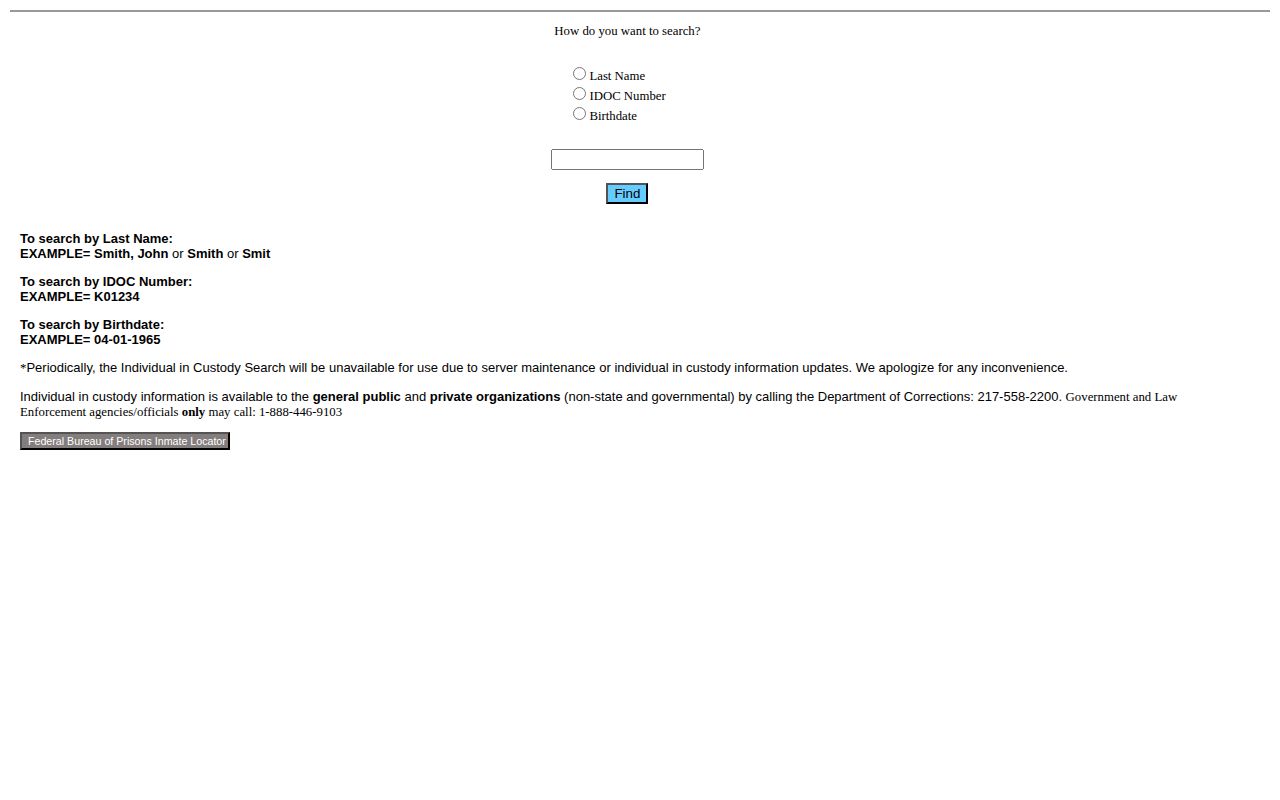
A saved result should include its capture date because projections and custody status can change.
IDOC Grundy Release Fields
The profile separates prison release from full sentence discharge. Projected Parole Date commonly means the expected physical departure from prison to mandatory supervised release, often called MSR. It is a projection, not proof the event occurred. Last Paroled Date is a past event field and gives stronger support for actual prison departure. Projected Discharge Date usually means the expected end of the whole IDOC sentence and supervision.
| IDOC field | How to read it |
|---|---|
| Offender Status | Current state-system status |
| Location | Institution, placement, or status location shown |
| Admission Date | State-custody intake date |
| Projected Parole Date | Expected prison departure to MSR |
| Last Paroled Date | Recorded past release to supervision |
| Projected Discharge Date | Expected end of sentence and supervision |
A person can be out of prison and still remain in IDOC legal custody on MSR. Do not describe that person as finally discharged. Conversely, an institution and “IN CUSTODY” status after a Grundy transfer confirms there was no community release from state custody.
Important: A projected date can move. Recheck the profile and use Last Paroled Date or an agency record after the expected event.
Grundy IDOC No-Match Limits
IDOC is not a permanent public discharge archive. Its no-match explanation expressly includes the possibility that a sentence is discharged because the person completed sentence or parole. A no-match can also arise because the person was held only by a county, is under another jurisdiction, or was searched under the wrong name.
For an older Grundy County state case, pair the court history with a focused written request to IDOC. The court can preserve the conviction, mittimus, sentence, and later entries even after the public IDOC profile disappears. Written confirmation is more dependable than inferring final discharge from absence alone. The Grundy County release-record overview explains how county, court, VINE, and IDOC records answer separate parts of the timeline.
- Parole
- Release from prison under state supervision in eligible cases.
- Mandatory supervised release
- A required community-supervision phase after many determinate prison terms.
- Final discharge
- The end of the IDOC sentence and supervision, not merely the prison exit.
- Mittimus
- The court commitment document supporting transfer into corrections custody.
IDOC Release Records Contact
A narrow request should identify the person and ask for existing fields tied to the state event: IDOC number, admission date, releasing institution or placement, actual release or Last Paroled Date, supervision status, and final-discharge date if one has occurred. Internal notification directives show that IDOC maintains richer release and placement data, but they do not guarantee public access to every field.
1301 Concordia Court
P.O. Box 19277
Springfield, IL 62794-9277
217-558-2200
For a supervision-location issue, IDOC publishes a parole-agent issue hotline at 800-666-6744. That line is for procedural help, not a public directory of every supervised person. Ask for the proper record and respect limits on private case details.
IDOC Dates Can Change
IDOC can revise a projected date after applying county custody credit, concurrent or consecutive sentence terms, program credit, earned discretionary credit, disciplinary loss or restoration, or a corrected court order. Illinois law has different credit structures for different offenses and dates. The common 50%, 75%, 85%, and 100% labels cannot be applied to every case without the actual statute and sentence facts.
The official sentence-credit page warns that discretionary credit cannot be predicted in advance. The revised public projection appears on the profile when calculated. For the narrow group whose release is accelerated by earned discretionary credit, IDOC maintains a special notice path. It is not a general release list and must not be used as one.
After an actual release, compare Last Paroled Date, current status, and Projected Discharge Date. The first supports prison departure. The status indicates whether supervision continues. The last addresses the expected end of the sentence, and should not be substituted for the gate date.
Grundy IDOC Release Scope
IDOC does not cover a person released after Grundy pretrial detention or a county-only sentence unless the court committed that person to state custody. Illinois VINE and Sheriff records are the local routes for those events. IDOC also does not establish that a person is free of federal, immigration, or another state's authority.
Identity must be matched with care. Use the IDOC number, birthdate, physical traits, photo when appropriate, sentencing county, and sentence rows. A same-name result is not enough. When the identifiers remain too weak, the correct result is an unconfirmed match.
The official search landing screenshot below keeps attention on the statewide scope of the source.
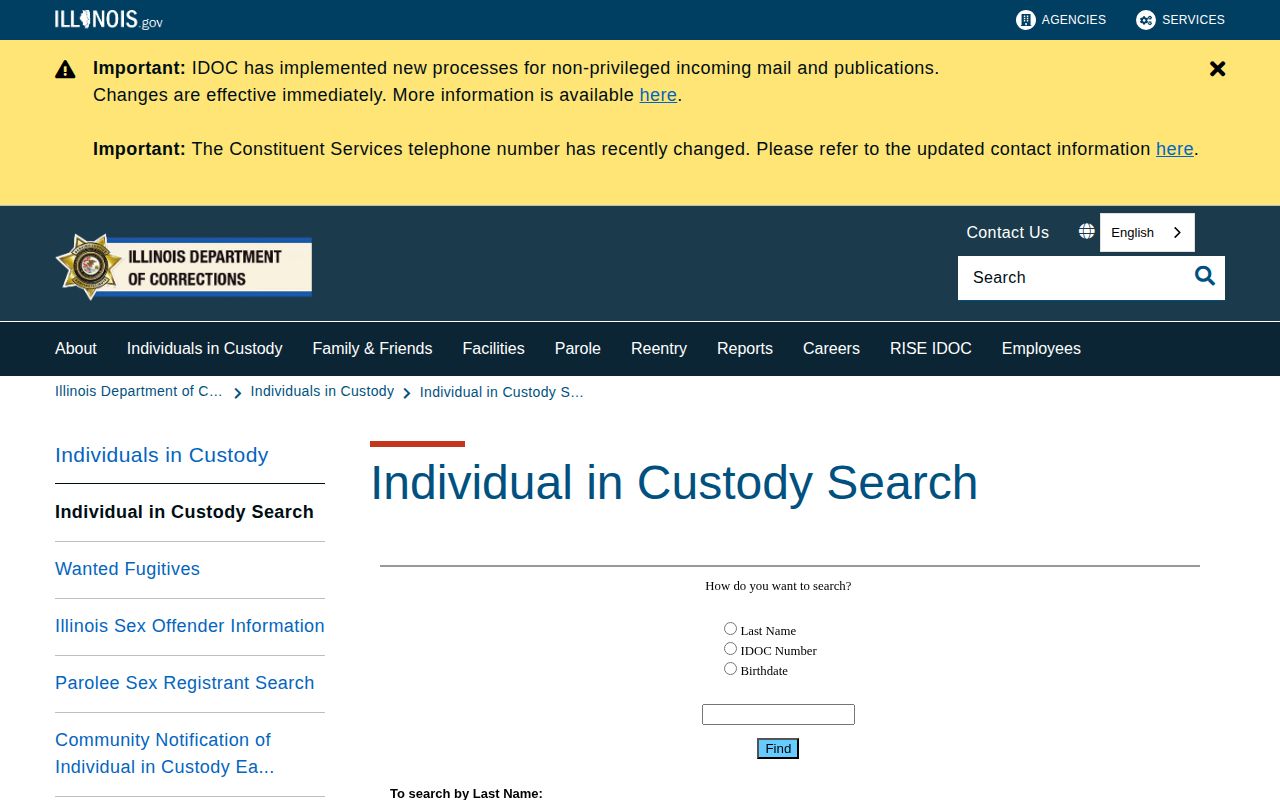
State custody records should be read alongside the Grundy commitment and any later supervision record.
Public Record Search
Sponsored Results