
Grundy Municipal Hold Paths
A municipal lockup is not the same as the Grundy County Jail. Police may temporarily hold a person during arrest processing, an initial investigation, transport, or the court process. The short hold can end in release under lawful authority or in transfer to the county jail. If the county never booked the person, the Sheriff may have no release row for that event.
No separate long-term municipal correctional facility or public municipal release archive was verified in Grundy County research. That finding should remain narrow. It does not mean police departments keep no custody records. It means there is no verified public web list that can be used as an archive of who left municipal custody.
| Possible path | Primary record | Next check |
|---|---|---|
| Released by police | Arresting agency custody record | Court disposition |
| Transferred to Grundy jail | Police transfer and jail receipt | VINE and Sheriff record |
| Transferred elsewhere | Sending agency destination | Receiving custodian |
| No county booking found | Municipal incident and custody records | Clerk or Judici case |
Trace Grundy Municipal Release
Begin with the arresting department, event date, and location. Those facts identify the likely records custodian. Ask whether the person was released from that agency or transported to another custodian. If records show transport to Grundy County Jail, confirm the jail's received time and later discharge or transfer event. A municipal departure alone does not describe what happened after county intake.
- Identify the police department and approximate arrest time.
- Search the Grundy court case for disposition and custody orders.
- Request the municipal receipt, release, or transfer entry.
- If transferred to the jail, check VINE and request the Sheriff custody row.
- If another destination appears, continue with that named custodian.
The exact Grundy Judici court search can show charges, docket entries, disposition, sentence, custody credit, and commitment or release orders where docketed. CAPTCHA may appear. The court order explains legal authority, while agency records explain physical movement.
The Judici screen below is the successful manifest image assigned to municipal lockup research.
Its case entries should be paired with the arresting agency's own custody record.
Municipal Release Record Fields
A precise records request should seek existing facts rather than a new narrative. Supply the full name, date of birth if known, event date, arrest location, and incident or case number. Ask for the time received into physical custody, the time released or transferred, the disposition or release code, the legal authority recorded for release, and the receiving facility or agency if there was a transfer.
- Incident number
- The municipal agency identifier connecting reports and custody records.
- Receipt time
- When the department took physical custody.
- Release time
- When that department stopped holding the person.
- Transfer destination
- The next custodian, often the county jail when recorded.
- Disposition code
- The agency's own label for how the hold ended.
Quote the agency label first. A “transport” or “transfer” entry cannot be translated as community release. If the requested office withheld part of the record, ask for segregable nonexempt fields. Juvenile, sealed, expunged, investigative, privacy, safety, and court-order limits may apply.
Grundy Court Copy Route
The Circuit Clerk maintains the court side of the event. Copies can document a pretrial-release order, dismissal, sentence, time-served disposition, probation, warrant, or commitment to IDOC. The court record can outlast a brief police hold, but it may not show the minute the department completed physical discharge.
111 E. Washington Street, Room 30
Morris, IL 60450
Mail: P.O. Box 707
815-941-3256
Criminal/traffic: 815-941-3260
Monday-Friday, 8:00 a.m.-4:30 p.m.
The official Clerk copy-request page lists its current process and fees. The first page is $2, pages 2 through 19 are 50 cents each, and pages from 20 onward are 25 cents each. Certification is $10 per document. Clerk mailing is $10 without a self-addressed stamped envelope, and a search is $6 when no case or document information is supplied.
The Clerk page shown below documents that separate court-record channel.
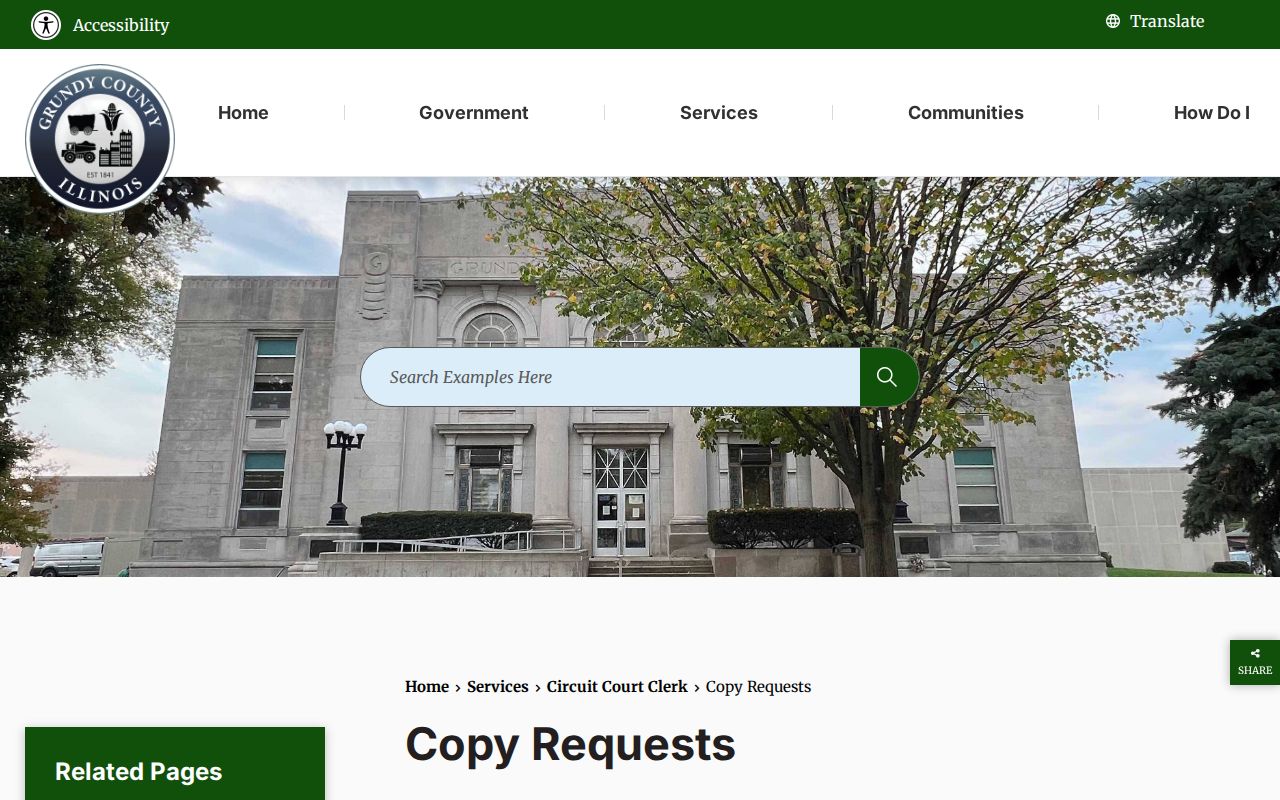
Those are court copy charges, not municipal police or Sheriff FOIA fees.
Municipal to County Transfer
When the police record identifies Grundy County Jail as the receiving facility, build a two-part timeline. The municipal transfer time shows the end of police custody. The jail receipt time shows county intake. Later, the Sheriff's discharge or transfer row shows how the county booking ended.
Illinois VINE may supply a timely jail custody event after county booking. Search by full name and an identifying detail, then verify the reporting agency. No VINE match does not prove the person was released or never booked. Data timing, name mismatch, and system coverage can all affect a result.
Important: A release from a police lockup and a release from Grundy County Jail are two different custody events.
The Grundy County release-record search explains the broader Sheriff, VINE, IDOC, court, and federal fallback chain for a person who moved beyond a municipal hold.
Grundy Probation After Release
A municipal arrest may end with a court disposition that includes probation. Grundy County Probation is a court-services office, not a public name-search roster. The court disposition and Clerk copy are the public route to establish the order. The office can provide procedural guidance within its authority, but silence from the office does not prove supervision ended.
111 E. Washington Street
Morris, IL 60450
815-941-3266
Fax: 815-941-3267
Probation differs from parole or mandatory supervised release. Probation arises from the county court order. IDOC Parole supervises eligible people after state prison. If a municipal case leads to an IDOC commitment, the state offender search becomes relevant only after state intake.
Municipal Archive Limits
There is no verified Morris or other Grundy municipal web archive of released arrestees. Do not substitute the absence of a web result for an agency record. Search-engine snippets and third-party copies can be stale, incomplete, or tied to the wrong person. The arresting department and court remain the primary sources.
For an older event, start with the case number when possible. Court records may preserve the disposition after a live custody interface has aged out. Then send the agency a date-bounded request. This approach reduces mistaken matches and helps the records officer locate the existing custody entry.
No verified municipal facility address, general release hour, public roster cadence, or web retention period is available to publish. Contact details should come from the specific arresting agency identified in the incident record, rather than assigning the county jail's information to every police department.
Municipal Identity Verification
A common name is not enough. Match the date of birth when lawfully available, incident number, arrest date, court case, and arresting agency. If the police event and court case do not align, pause the conclusion and ask for the agency identifier. A false match can create a more serious error than a missing record.
Keep every statement tied to one custodian. Say the municipal department released or transferred the person on the recorded date. Say Grundy County Jail later received the person only if the county record supports it. This wording preserves the real difference between a short police hold and county detention.
Public Record Search
Sponsored Results